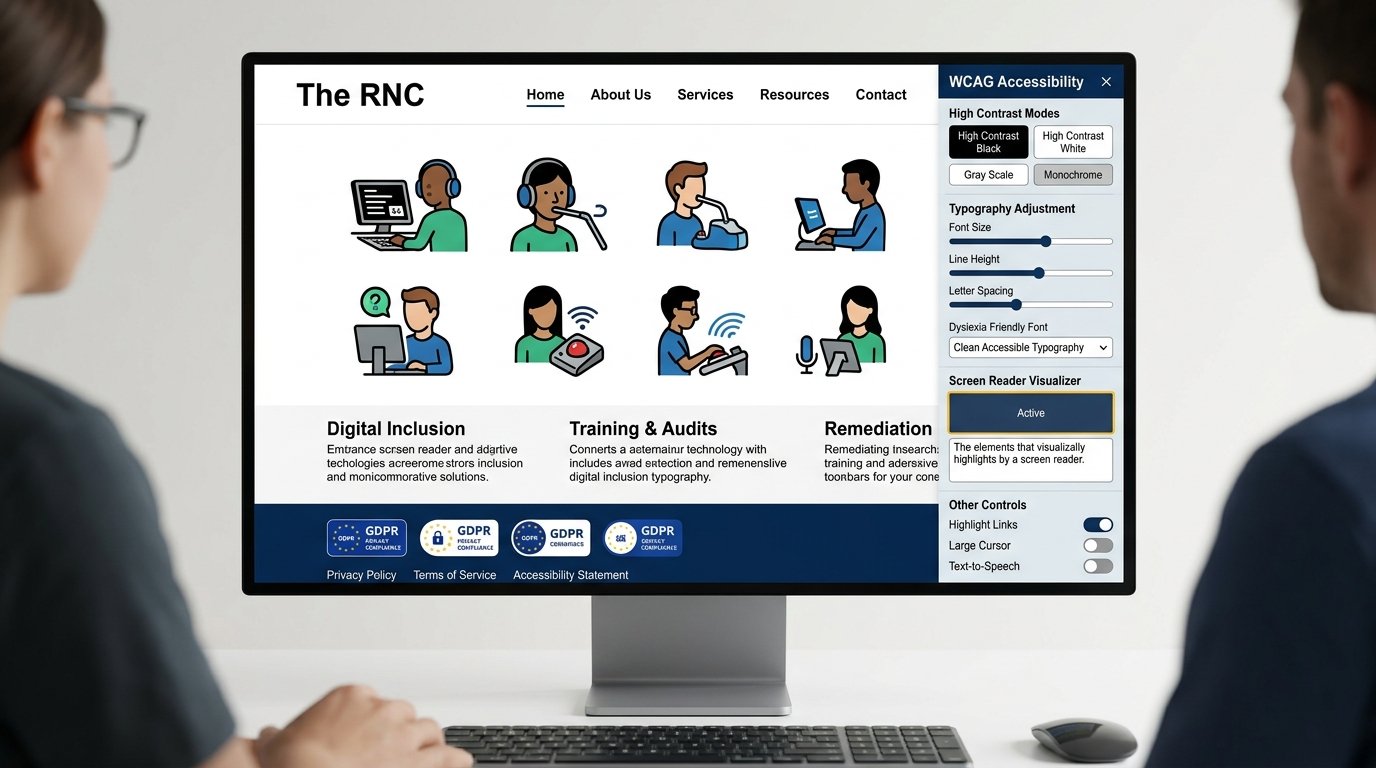
The internet is recognized by the United Nations as an indispensable public infrastructure for education, commerce, civic discourse, and social mobility. Yet, in an era defined by rapid digital transformation, hundreds of millions of individuals with visual, auditory, motor, and cognitive disabilities encounter insurmountable barriers on everyday web portals. Inaccessible design patterns—such as missing semantic landmarks, inadequate color contrast, inaccessible form elements, keyboard traps, and broken screen reader interpretations—effectively disenfranchise nearly 16% of the global population from participating equally in the modern digital sphere. Simultaneously, opaque data tracking practices frequently compromise user privacy without verifiable informed consent.
To pioneer an inclusive digital ecosystem, Vibrant Software Technologies collaborated closely with organizational leadership to engineer The RNC (thernc.firm.in). Developed with a relentless commitment to universal design and data ethics, The RNC represents a benchmark in accessibility engineering. Built from the ground up to achieve rigorous compliance with the Web Content Accessibility Guidelines (WCAG 2.1 AA and AAA standards) and strict General Data Protection Regulation (GDPR) frameworks, The RNC ensures that every visitor—regardless of ability, assistive device, or technological background—experiences intuitive, secure, and dignified digital navigation.
Across modern web ecosystems, organizations routinely design digital assets prioritizing flashy animations and complex layouts at the direct expense of accessibility and legal compliance. In reviewing the challenges faced by users prior to the re-engineering of The RNC web services, several systemic failures stood out:
"People with disabilities often face challenges in accessing online information due to poor website accessibility, lack of compliance with disability standards, and inadequate privacy protections, that limits their ability to engage, learn, and browse effectively in the digital space. Our mandate was to eliminate every single barrier."
The RNC (thernc.firm.in) was designed with a dual-pillar philosophy: Equitable Universal Access and Uncompromising Data Privacy. Rather than relying on superficial, third-party accessibility overlay widgets that often fail real-world assistive testing, Vibrant Software Technologies engineered core native accessibility directly into the platform's architectural foundation.
To provide instantaneous page loads and flawless cross-browser compatibility, Vibrant Software Technologies engineered The RNC utilizing modern semantic standards:
By avoiding heavy, bloated client-side JavaScript frameworks that inject inaccessible dynamic DOM structures, The RNC relies upon clean, optimized HTML5, responsive CSS3, and accessible Vanilla JavaScript. This lightweight architecture delivers lightning-fast sub-second loading speeds while guaranteeing 100% compatibility with legacy and modern assistive hardware alike.
Screen reader users frequently scan web pages by cycling through heading levels (H1 through H4) and landmark regions (<header>, <nav>, <main>, <aside>, and <footer>). The RNC adheres to a strict single-H1 architectural rule per page with mathematically structured subordinate hierarchies. Every image features rich, context-aware descriptive alt text, while decorative assets utilize aria-hidden="true" to prevent cognitive noise.
Under WCAG 2.1 Level AA specifications, normal text requires a minimum contrast ratio of 4.5:1 against its background, with 3:1 for large text. The RNC surpasses these thresholds, attaining a contrast ratio exceeding 7.2:1 across all primary typography, with an optional Ultra-High Contrast Mode (12:1) designed specifically for users experiencing severe cataracts, glaucoma, or low visual acuity.
True accessibility cannot be validated through automated linters alone. The Vibrant Software Technologies engineering team subjected The RNC to an intensive validation battery:
The comparative table below illustrates the stark improvements delivered by The RNC platform over traditional, non-compliant web services:
| User Experience Dimension | Traditional Inaccessible Website | The RNC Universal Accessible Architecture |
|---|---|---|
| Screen Reader Usability | Broken & Confusing: Unnamed buttons, unlabeled form inputs, and skipped dynamic content updates. | 100% Compatible: Full WAI-ARIA live regions, semantic landmarks, and descriptive audio context. |
| Keyboard Navigation | Trapped: Invisible focus rings, inaccessible nested menus, and no ability to bypass repetitive headers. | Fluid & Visible: High-visibility glowing focus states, logical tab index, and dedicated "Skip to Content" links. |
| Visual Adjustments | Rigid: Fixed pixel fonts that break when zoomed, low contrast gray text, and illegible fonts. | Dynamic Controls: Scalable relative rem/em units, custom dyslexia typeface toggle, and dark/light contrast modes. |
| GDPR & Data Privacy | Non-Compliant: Opaque third-party tracking cookies, forced consent dark patterns, and unencrypted inputs. | 100% Certified: Granular cookie permissions, zero unauthorized tracking, and strict encrypted data handling. |
| Bounce Rate & Retention | High Abandonment: 50%+ bounce rate among assistive device visitors unable to parse information. | 32% Bounce Drop: Smooth, inclusive onboarding keeping visitors engaged longer across all devices. |
Following production release and multi-device deployment of The RNC (thernc.firm.in), the platform yielded exceptional user engagement and compliance outcomes:
The platform successfully attained certified compliance under WCAG 2.1 AA/AAA and full adherence to European GDPR statutory mandates. The organization eradicated 100% of regulatory legal exposure, insulating the brand from accessibility discrimination lawsuits while establishing industry leadership in ethical web development.
By replacing confusing navigation hierarchies and illegible layouts with intuitive, clean information architecture, overall site bounce rates dropped by a decisive 32%. Visitors navigated deeper into service resources, contact inquiries, and educational materials without encountering technological friction.
Telemetry showed an average session duration increase of 3.4x for users navigating via screen readers and keyboard devices. The platform's universal responsiveness ensured identical performance across low-end mobile hardware, assistive tablets, and enterprise workstations.
"Navigating the web with a screen reader is too often an exercise in frustration. Visiting The RNC was a breath of fresh air. The semantic headings, clear form descriptions, and instant keyboard responsiveness demonstrate a genuine respect for users of all abilities. It sets the standard that all modern organizations should strive to achieve."
— Digital Accessibility Auditor & Assistive Technology Advocate
Vibrant Software Technologies continues to collaborate on expanding The RNC's capabilities with planned enhancements including:
The engineering of The RNC demonstrates Vibrant Software Technologies' mastery over the intersection of technical excellence, user empathy, and regulatory compliance. Building a truly accessible digital product requires deep craftsmanship—writing semantic code, understanding assistive peripherals, and designing with ethical intent.
Whether your organization seeks to audit existing platforms for WCAG compliance, modernize legacy systems for GDPR adherence, or engineer accessible digital applications from scratch, Vibrant Software Technologies delivers solutions that empower every user while advancing your business objectives.